

Incident Response & Forensics
Technical analysis when something has already gone wrong.
Service overview
Contain first, explain next, report last.
The first hours of an incident are about decisions: what to pause, which keys to rotate, who to tell. The investigation that follows reconstructs every transaction, follows the funds and explains why the controls in place did not stop the attack.
We work alongside your team, not instead of it. Containment options are presented with their trade-offs for you to decide; tracing records why each address is attributed the way it is; the report is written for your engineers first and published only if you choose.
Incident support is subject to availability at the time of request. If you need agreed response commitments, they are set in writing during scoping, before anything happens.
- Typical triggers
- Exploits, key compromise, malicious upgrades, phishing campaigns
- Your decisions
- Containment, disclosure and publication remain yours
- Availability
- Subject to availability; no guaranteed response times
Applies to
- Exploited or suspected-compromised contracts
- Compromised keys and signing infrastructure
- Frontend or DNS compromise
- Bridge and cross-chain incidents
- Governance and admin-key misuse
If funds are at risk right now
Six things to do before anyone else arrives.
These steps apply whether or not you engage Quantix. They protect what remains and preserve what an investigation will need.
- 1
Contain what you can
If your contracts have a pause, guardian or circuit breaker, use it. Revoke roles or approvals you know to be compromised. Take affected frontends offline if they may be serving malicious transactions.
- 2
Preserve evidence
Do not wipe or redeploy servers yet. Snapshot logs from frontends, APIs, RPC providers and CI. Export the chat threads where the incident was first discussed.
- 3
Rotate exposed credentials
From a clean machine, rotate keys and secrets that may be exposed: deployer and admin keys, API keys, CI secrets, DNS and hosting accounts.
- 4
Keep the investigation private
Coordinate in a closed channel with named participants. Warn users to stop interacting if the risk continues, but avoid publishing technical details before the attack path is understood.
- 5
Start a timeline
Write down what was noticed, when and by whom, and every action taken since. It will be the backbone of the investigation and the report.
- 6
Contact the right parties
Bring in your security partners, and the teams operating bridges or exchanges funds may flow through. Consider whether to involve law enforcement.
Quantix provides incident support subject to availability at the time of request. Response times are agreed per engagement and are not guaranteed through this website.
Threats addressed
The incidents we are asked to investigate.
- Key compromise
Admin or deployer key used by an attacker
Roles transferred, implementations replaced or funds moved by a key that should have been safe.
- Upgrade risk
Malicious or faulty upgrade
A proxy pointed at new logic that drains funds, disables checks or locks users out.
- Oracle manipulation
Price-driven exploit
A pool or feed moved within a block to borrow against inflated collateral or liquidate healthy positions.
- Flash-loan exploit
Single-transaction drain
Borrowed capital used to break an invariant and repaid in the same transaction, leaving a loss behind.
- Bridge message validation
Forged or replayed messages
Funds released on one chain without a matching, valid deposit on the other.
- Signature phishing
User approvals drained
A campaign that collects permits or approvals and sweeps balances from many holders.
- Frontend supply chain
Compromised interface
A hijacked domain, CDN or dependency serving transactions to an attacker’s contracts.
- Governance manipulation
Hostile proposal
Voting power accumulated or borrowed to pass a proposal that moves treasury funds or roles.
- Liquidity risk
Liquidity pulled
Pool liquidity or reserves withdrawn by insiders, leaving holders unable to exit.
Technical capabilities
Every hop annotated, every assumption stated.
Transaction reconstruction
Attack transactions decoded call by call, with state diffs and internal calls.
- Traces and state diffs
- Fork replay at the exploit block
On-chain tracing
Funds followed across addresses, swaps and bridges, with every attribution reasoned.
- Hop-by-hop annotation
- Exit points per chain
Attack-path analysis
Preconditions, the vulnerability, and the attacker’s exact sequence of actions.
- Preparation transactions
- Funding sources
Evidence preservation
Logs, artefacts and communications secured with a record of who collected what, and when.
- Hashes of collected files
- Chain-of-custody log
Containment design
Options to stop further loss, with what each costs and what it risks.
- Pause, revoke, rotate
- User communication
Root cause and reporting
Why it happened, why controls missed it, and what changes.
- Internal report
- Optional public post-mortem
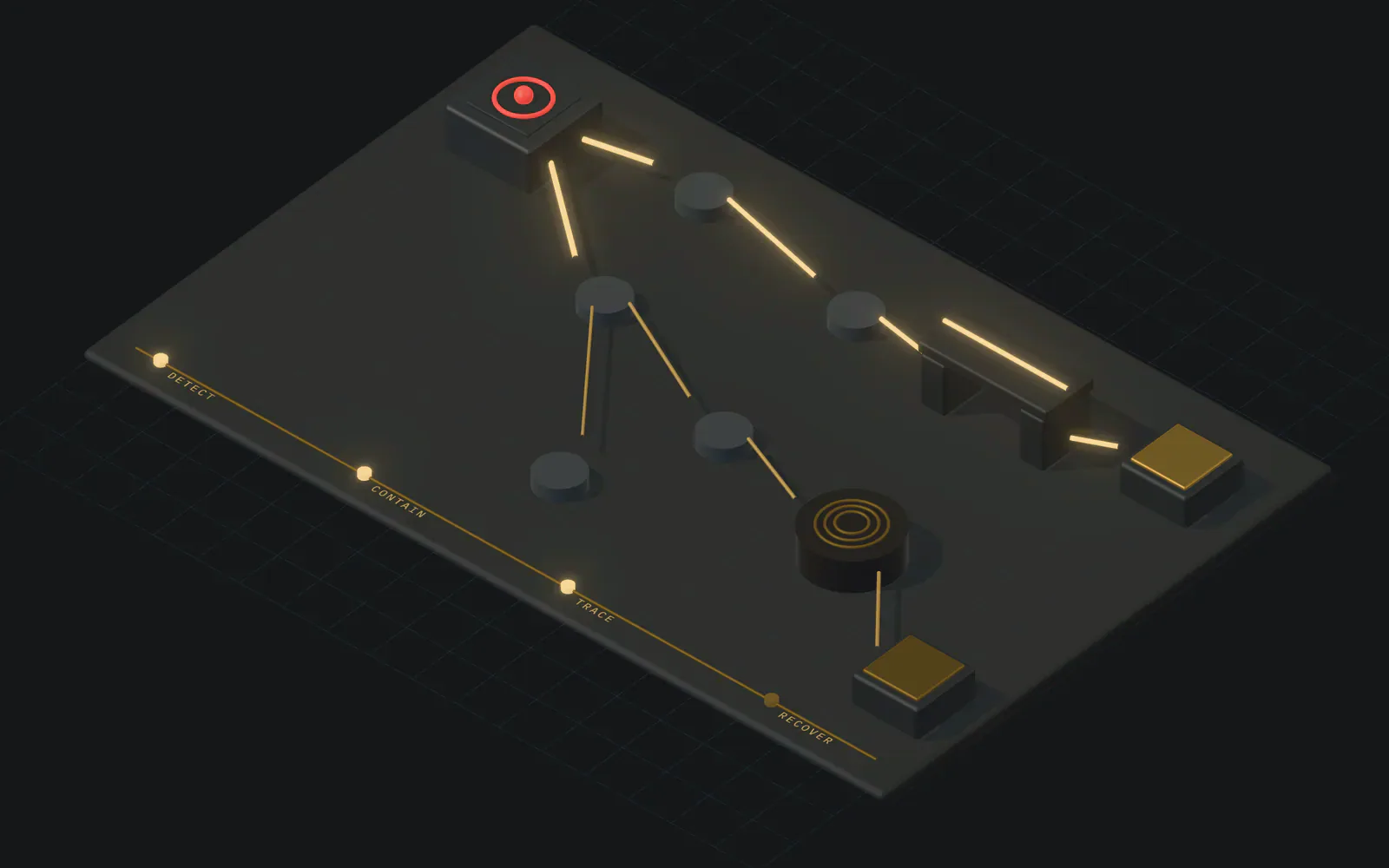
Illustrative trace. Nodes are labelled by role; a real trace records the address, the transaction and the reasoning behind every attribution.
Assessment methodology
Eight steps in three windows.
- 1First hoursSteps 01–03
- 2Following daysSteps 04–06
- 3After containmentSteps 07–08
- 01
Initial triage
Establish what is affected, whether the attack is ongoing, and which assets remain at risk.
- 02
Evidence preservation
Secure logs, deployment artefacts and communications before they are lost or overwritten.
- 03
Containment recommendations
Concrete options to stop further loss, with the trade-offs of each, for your team to decide.
- 04
Transaction reconstruction
Decode the attack transactions call by call, including state changes and internal calls.
- 05
On-chain tracing
Follow funds across addresses, swaps and bridges, and annotate where they leave the chain under analysis.
- 06
Attack-path analysis
Identify the precondition, the vulnerability and every step the attacker took to exploit it.
- 07
Root-cause assessment
Explain why the vulnerability existed and why existing controls did not stop it.
- 08
Post-incident reporting
A written report for your team, and a public version if you choose to publish one.
Tools & techniques
Reproducible analysis, from raw traces to a written timeline.
| Tool or technique | Category | What it is used for |
|---|---|---|
| Foundry cast run / trace | Reconstruction | Replays a transaction locally with full call trace and decoded calldata. |
| debug_traceTransaction, prestate tracer | Reconstruction | Internal calls and exact state before and after each attack transaction. |
| Fork replay (anvil --fork-block-number) | Validation | Reproduces the exploit at the block it happened, and tests whether a proposed fix stops it. |
| Address graph analysis | Tracing | Builds the fund-flow graph across hops, swaps and bridges, with attribution notes per node. |
| Cross-chain message lookups | Tracing | Matches bridge deposits and releases across chains using each protocol’s message identifiers. |
| Verified source and ABI decoding | Analysis | Decodes attacker and victim contracts; unverified bytecode is decompiled and annotated. |
| SHA-256 evidence manifests | Evidence | Every collected log and artefact hashed and recorded with collector and time. |
| Incident timeline | Coordination | Single ordered record of observations, decisions and actions, shared with your team. |
Ecosystem coverage
Technical depth per execution environment.
Ethereum
Layer 1, proof of stake EVM
- Programming languages
- SolidityVyperYul
- Typical vulnerabilities
- Reentrancy, including read-only reentrancy
- Oracle and spot-price manipulation
- Access control on privileged functions
- Proxy storage collisions and initializer misuse
- Signature replay across chains and contracts
- Front-running and MEV exposure
- Assessment methodologies
- Line-by-line manual review
- Invariant fuzzing (Foundry, Echidna)
- Symbolic execution and formal verification
- Economic attack modelling
- Monitoring capabilities
- Proxy admin and implementation changes
- Governance proposals and timelock queues
- Large transfers and treasury outflows
- Oracle deviation against reference feeds
- Supported standards
- ERC-20ERC-721ERC-1155ERC-4626EIP-2612EIP-712ERC-1967ERC-4337
Ecosystems indicate technical specialisation only, not partnerships or endorsements.
Deliverables
What incident support covers, and what you receive.
Triage memo
What is affected, what remains at risk, and the containment options with their trade-offs.Transaction reconstruction
Each attack transaction decoded, with state changes and the attacker’s preparation.Fund-flow trace
Annotated graph of where funds went, where they left the chain, and how each step was attributed.Evidence manifest
Hashed list of collected logs and artefacts with chain-of-custody notes.Root-cause report
The vulnerability, why controls did not stop it, and the changes recommended.Post-mortem draft
A public version for your review, published only with your approval.
Key assessment areas
- Initial incident triage
- Transaction reconstruction
- On-chain fund tracing
- Attack-path analysis
- Evidence preservation
- Containment recommendations
- Root-cause assessment
Typical deliverables
- Triage summary and immediate recommendations
- Annotated transaction timeline
- Fund-flow trace with address annotations
- Root-cause analysis
- Post-incident report and hardening plan
Relevant research
Read the work behind the service.
Publications
- Incident AnalysisAnatomy of cross-chain bridge exploits
- Threat IntelligenceDetecting suspicious on-chain behaviour before the exploit transaction
- Wallet SecurityOff-chain signatures, on-chain losses: the anatomy of approval phishing
- DeFi SecurityUnderstanding oracle manipulation: designs and their failure modes
- DeFi SecurityGovernance attacks in DeFi
FAQ
Questions teams ask before an engagement
Incident inquiry
Tell us what is happening.
Inquiries are reviewed as they arrive. We will tell you whether we can take the engagement, and agree a secure channel before discussing details.
Useful to include
- Affected chain and contract addresses
- Transaction hashes you have identified
- What has been done so far
- Who is on your response team
Never send private keys, seed phrases or credentials.

Prepare before you need it.
An incident plan, monitoring of privileged operations and a rehearsed pause procedure make the first hours of an incident shorter and calmer.