

Security Research & Advisory
Security decisions made early, while they are still cheap.
Service overview
Security reasoning, applied while the design can still change.
An audit tests code that exists. Many of the most expensive findings, though, trace back to decisions made long before the code was written: a single admin key, an upgrade path with no delay, an oracle with one source, a bridge that trusts a small committee. At design stage those are conversations; after deployment they are rewrites.
Advisory brings the same adversarial reasoning used in audits to architecture documents, threat models, key-management plans and governance parameters. The output is a set of written decisions with the reasoning behind them, ranked by the loss they prevent.
Independence is protected. If we advise on a design, any later audit report from Quantix discloses that, and you may prefer a different reviewer for the audit itself.
- Best timing
- Before the design is fixed, and between audits
- Formats
- Architecture review, threat-model workshop, ongoing advisory
- Output
- Memos, threat models and checklists your team keeps
Applies to
- Protocols in design or pre-audit stages
- Key-management and custody architectures
- Governance and upgrade frameworks
- Cross-chain and bridge designs
- Security programmes for growing engineering teams
Threats addressed
Design decisions that become critical findings later.
- Key compromise
Single key with unlimited power
An owner or admin key that can upgrade, mint or drain, with no threshold, delay or scope limit.
- Upgrade risk
Upgrades without a delay
Implementation changes that take effect immediately, leaving users no time to react to a malicious or faulty release.
- Oracle manipulation
One price source
Prices read from a single pool or feed, with no deviation checks, staleness limits or circuit breakers.
- Governance manipulation
Capturable governance
Voting power that can be borrowed, low quorums, or proposals that execute before anyone can review them.
- Bridge message validation
Small trust committees
Cross-chain designs where a handful of signers or a single relayer can release funds on another chain.
- Business logic
Unwritten invariants
No written statement of what must always hold, so neither tests nor reviewers can check it.
- Composability risk
Unexamined dependencies
Assumptions about external tokens, vaults or lending markets that nobody has written down or tested.
- Infrastructure exposure
Operational keys on servers
Keepers, relayers and deployers holding keys on infrastructure with a broad attack surface.
- Incident readiness
No plan for the first hour
No tested pause, no named roles and no prepared communications when something goes wrong.
Technical capabilities
Eight areas of security advisory.
Protocol architecture review
Contract boundaries, trust assumptions, upgrade paths and external dependencies, reviewed while they can still change cheaply.
Threat modeling
Who could attack the system, through which boundary, with what gain. Prioritised so effort goes where loss would be largest.
Secure development practices
Review gates, testing strategy, invariant and fuzz testing, dependency management and release discipline for contract code.
Key-management architecture
Which keys exist, who holds them, how they sign, how they rotate, and what a single compromised key could do.
Governance security
Multisig thresholds, timelock delays, proposal validation and the paths by which governance itself could be captured.
Infrastructure risk assessment
Frontends, RPC providers, keepers, CI pipelines and cloud accounts: the operational dependencies of on-chain code.
Security-readiness planning
What to fix, review and monitor before launch, in what order, and how to sequence audits against the release plan.
Incident readiness
A written response plan, named roles, a tested pause procedure and the communications to prepare in advance.
Assessment methodology
From the question you have to a decision you can defend.
- 01
Frame the decision
Agree the question, the milestone it serves and what a useful answer looks like.
- 02
Gather design material
Architecture documents, diagrams, early code, governance parameters and operational runbooks.
- 03
Map trust boundaries
Draw where trust changes hands and which actors, keys and dependencies sit on each side.
- 04
Threat model and prioritise
Enumerate threats per boundary and rank them by the loss they would cause and how likely they are.
- 05
Recommend and review
Written recommendations, reviewed with your engineers so they are practical as well as correct.
- 06
Plan the next milestone
A readiness plan for launch or audit, with what to fix, test and monitor first.
Draw the boundaries, then ask what crosses them.
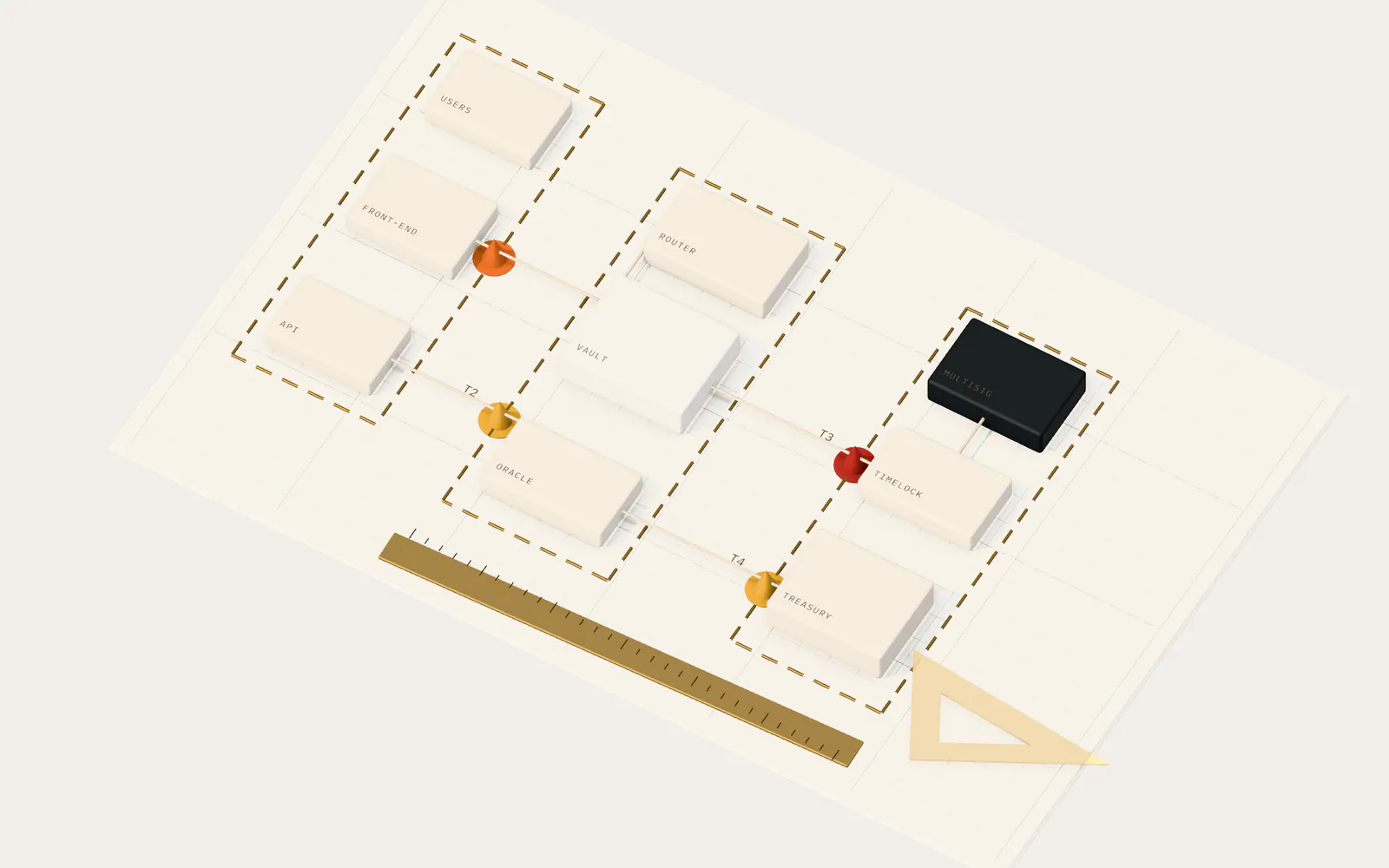
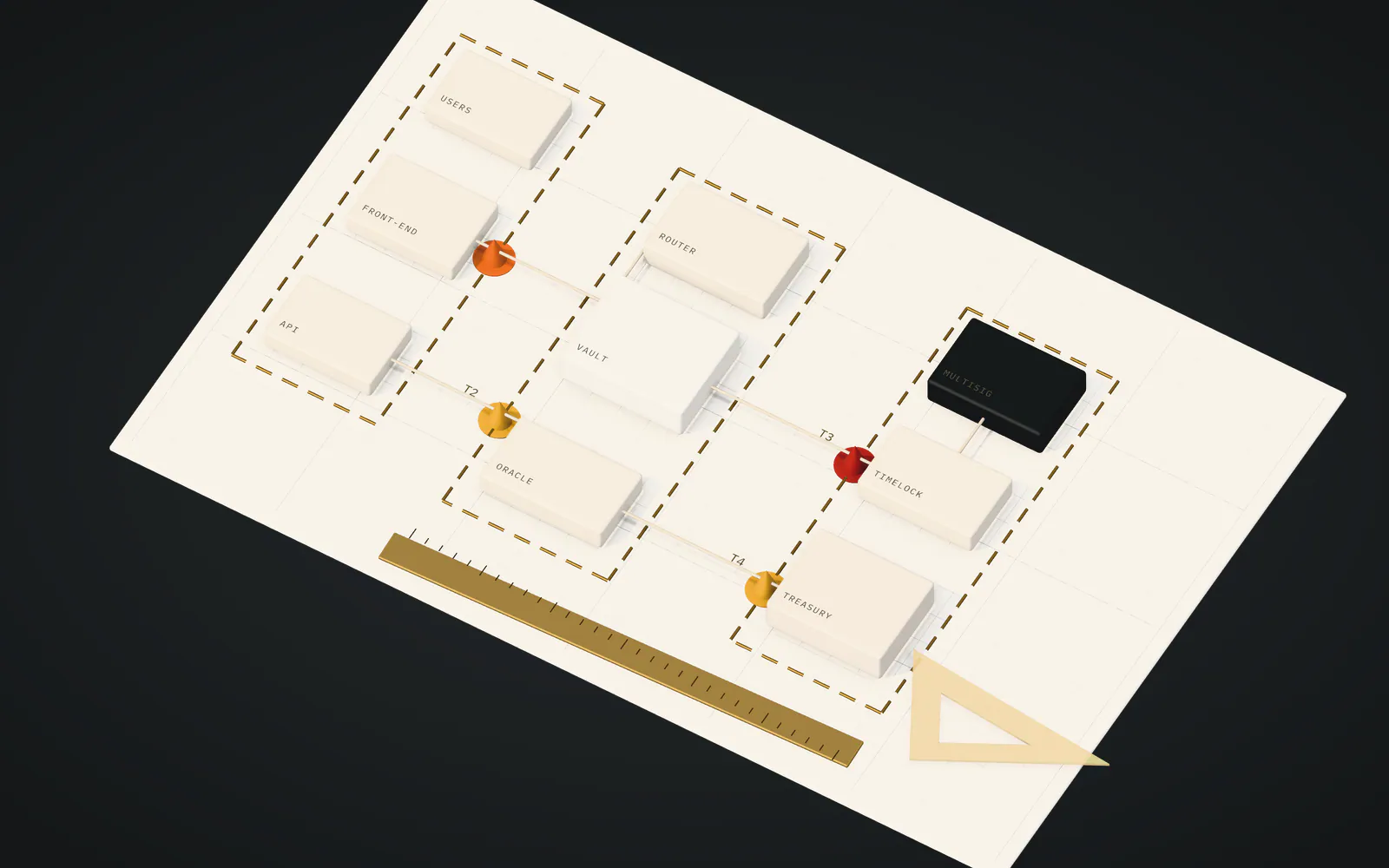
A threat model maps where trust changes hands: between users and the frontend, operators and contracts, governance and code, contracts and their dependencies. Each boundary gets its threats and the controls that answer them.
| ID | Boundary | Threat | Typical mitigation |
|---|---|---|---|
| T1 | Users → frontend | Malicious transaction served by a compromised frontend | Subresource integrity, DNS and hosting hardening, transaction simulation in the wallet |
| T2 | Users → contracts | Price manipulation within a single transaction | Manipulation-resistant pricing, deviation guards, bounded actions per block |
| T3 | Operations → contracts | Leaked keeper or deployer key used to call privileged functions | Least-privilege roles, separate keys per function, monitoring of privileged calls |
| T4 | Governance → contracts | Malicious or mistaken upgrade executed without review | Timelock with enforced minimum delay, release hash verification, public queue |
| T5 | Dependencies → contracts | Stale or manipulated oracle value accepted | Staleness and deviation checks, fallback feed, circuit breaker |
| T6 | Contracts → bridge | Forged cross-chain message accepted | Message verification review, rate limits, independent watchers |
Illustrative threat model for a generic DeFi protocol. Not drawn from a client engagement.
Three formats, chosen by the question you need answered.
Advisory engagements are scoped in reviewer-days around a specific decision, design or milestone, and end with written output.
Architecture review
A focused review of a design document or early codebase, delivered as a written memo with prioritised recommendations and a walkthrough with your engineers.
Threat-model workshop
Working sessions with the people who built the system, producing a threat model the team owns and updates as the protocol changes.
Ongoing advisory
A standing arrangement for design reviews, second opinions on findings and security questions as they arise, scoped in reviewer-days per month.
Tools & techniques
Public frameworks, adapted to how protocols actually fail.
| Tool or technique | Category | What it is used for |
|---|---|---|
| STRIDE per trust boundary | Threat modeling | Structured enumeration of spoofing, tampering, repudiation, disclosure, denial and elevation threats at each boundary. |
| Attack trees | Threat modeling | Breaks a high-value goal, such as draining the treasury, into the paths that reach it and the controls on each. |
| Data-flow and trust-boundary diagrams | Architecture | Shared picture of components, actors, keys and dependencies that the threat model is built on. |
| OWASP Smart Contract Top 10 and SCSVS | Checklists | Public references for smart contract weakness classes and verification requirements. |
| EEA EthTrust Security Levels | Checklists | Public specification of security requirements for EVM smart contracts, used as a reference. |
| NIST SP 800-57 principles | Key management | Key lifecycle, separation of duties and rotation principles applied to signer and multisig design. |
| Slither printers | Architecture | Inheritance, call-graph and authorisation summaries that check the code matches the intended design. |
| Governance parameter review | Governance | Thresholds, quorums, voting periods and timelock delays compared with the actions they protect. |
Ecosystem coverage
Technical depth per execution environment.
Ethereum
Layer 1, proof of stake EVM
- Programming languages
- SolidityVyperYul
- Assessment methodologies
- Line-by-line manual review
- Invariant fuzzing (Foundry, Echidna)
- Symbolic execution and formal verification
- Economic attack modelling
- Typical vulnerabilities
- Reentrancy, including read-only reentrancy
- Oracle and spot-price manipulation
- Access control on privileged functions
- Proxy storage collisions and initializer misuse
- Signature replay across chains and contracts
- Front-running and MEV exposure
- Monitoring capabilities
- Proxy admin and implementation changes
- Governance proposals and timelock queues
- Large transfers and treasury outflows
- Oracle deviation against reference feeds
- Supported standards
- ERC-20ERC-721ERC-1155ERC-4626EIP-2612EIP-712ERC-1967ERC-4337
Ecosystems indicate technical specialisation only, not partnerships or endorsements.
Deliverables
Documents your team keeps using after we leave.
Architecture memo
Findings and recommendations on the design, ranked by risk, with the reasoning behind each.Threat model
Trust boundaries, threats and controls, in a format your team can maintain as the protocol changes.Key-management matrix
Every key and role, who holds it, what it can do, how it rotates and what its compromise would cost.Governance review
Thresholds, delays and proposal paths assessed against the actions they protect.Readiness plan
What to fix, test and monitor before launch or audit, in priority order.Incident plan outline
Roles, pause procedure and first communications, ready to rehearse.
Key assessment areas
- Protocol architecture review
- Threat modelling
- Secure development practices
- Key-management architecture
- Governance security
- Infrastructure risk assessment
- Security-readiness planning
Typical deliverables
- Architecture review memo
- Threat model with prioritised mitigations
- Key-management and governance recommendations
- Audit-readiness checklist
- Security roadmap
Is your code ready to be audited?
Teams that arrive with a frozen commit, a written description of intended behaviour and a passing test suite get more from the same review time. Use the checklist to see where you stand. Nothing you tick is stored or sent.
Request an Assessment0 of 14 in place
Tick what is already in place.
Relevant research
Read the work behind the service.
Publications
- Smart Contract VulnerabilitiesUpgradeable proxy security: storage, selectors and the upgrade path
- DeFi SecurityGovernance attacks in DeFi
- Incident AnalysisAnatomy of cross-chain bridge exploits
- Smart Contract VulnerabilitiesInitializers, proxies and the contract nobody owns
- Blockchain InfrastructureMEV and protocol risk
FAQ
Questions teams ask before an engagement

Make the security decisions while they are still cheap.
Share a design document, a repository or just the question you are trying to answer. We will tell you which kind of review would help most.