

Formal Verification
Machine-checked reasoning about properties that must always hold.

Service overview
A proof is only as good as the sentence it starts from.
Testing checks the paths you thought of. Verification asks a stronger question: is there any sequence of calls, by anyone, with any inputs, that breaks this property? When the answer is yes, the tool returns a concrete counterexample. When it is no, the property holds for the code in scope under the stated assumptions.
Most of the value is created before any tool runs. Writing a property precisely forces ambiguity in the requirement into the open: what exactly must hold for share accounting, liquidation, or a timelock queue. Properties are written twice, in plain language your team can agree with and in a formal notation a tool can check.
Verification complements manual review; it does not replace it. Every result is reported with the assumptions it depends on and the properties that were not proved.
- Best suited to
- Accounting cores, vaults, liquidation, timelocks, bridges
- Result types
- Proved, violated (with counterexample), inconclusive
- Handover
- Specifications and harnesses you keep in CI
Applies to
- Core accounting and solvency logic
- Token and vault share mechanics
- Lending and liquidation engines
- Governance and timelock state machines
- Bridge message validation
- Protocol upgrades with invariant-preserving requirements
Threats addressed
Failures that only appear on paths nobody tested.
- Precision and rounding
Conservation violations
Value created or destroyed by rounding, fee accrual or share conversion on some sequence of deposits and withdrawals.
- First-depositor attack
Share-price manipulation
States where the ratio of assets to shares can be pushed far enough that later deposits mint nothing.
- Business logic
Insolvency paths
Sequences of borrows, price moves and liquidations that leave debt uncovered by collateral.
- Governance manipulation
Early or repeated execution
A queued action executed before its delay, executed twice, or executed after cancellation.
- Access control
State changed by the wrong role
Any path, including through a callback or delegatecall, by which an unprivileged caller changes privileged state.
- Bridge message validation
Replay and double processing
A message accepted twice, out of order, or for a destination or nonce it was not signed for.
Technical capabilities
Six kinds of statement that catch most critical bugs.
State invariants
Relationships that must hold between storage variables in every reachable state.
- totalSupply == Σ balanceOf(a)
Conservation
Value is neither created nor destroyed except by the functions designed to do so.
- assets_in − assets_out == Δ totalAssets
Safety properties
Something bad never happens, whatever sequence of calls an attacker chooses.
- executed(id) ⇒ now ≥ eta(id)
Access control
Only the intended roles can change a given piece of state, on every path.
- Δ fee ⇒ msg.sender == governor
Monotonicity and ordering
Values that may only grow, nonces that never repeat, states that cannot be revisited.
- nonce' > nonce
Equivalence
A refactored or optimised implementation behaves exactly like the version it replaces.
- ∀ s, x: v1.f(s, x) == v2.f(s, x)
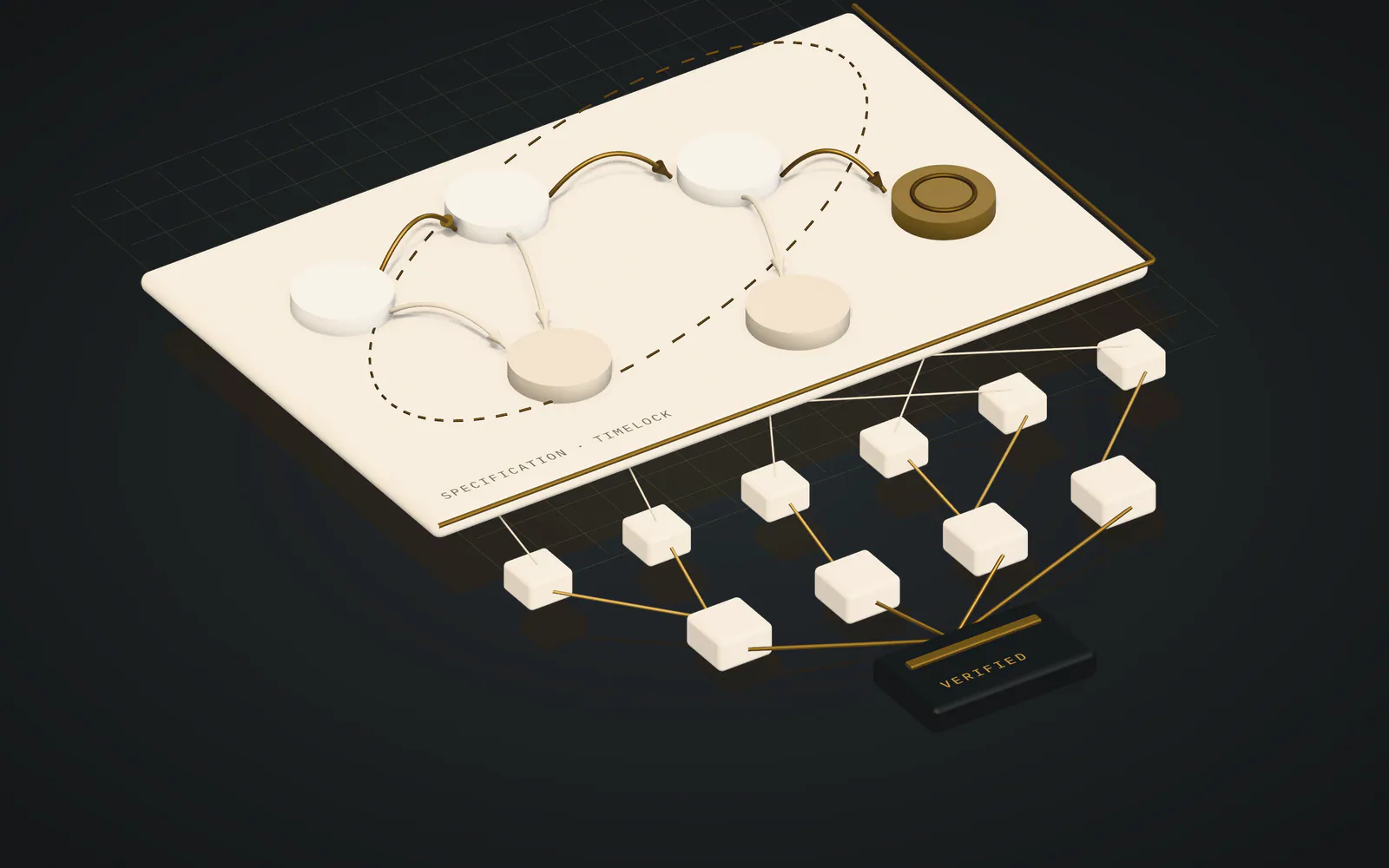
A governance timelock, simplified. Tests confirm that a queued proposal executes after its delay. A safety property asks whether any sequence of calls, by anyone, executes a proposal early.
Assessment methodology
From requirement to machine-checked result.
- 01
Specification workshop
Agree which properties matter, the contracts and assumptions in scope, and which results would change your launch decision.
- 02
Formal specification
Requirements written in plain language and in formal notation; ambiguity resolved with your engineers.
- 03
Mathematical reasoning
Properties decomposed into lemmas about individual functions and transitions, so failures point to a specific step.
- 04
Model checking
Bounded exploration of call sequences up to a stated depth, returning a concrete trace for any violation.
- 05
Proof-oriented verification
Inductive proofs that each transition preserves the property, for any number of calls.
- 06
Counterexample analysis and report
Each violation reproduced as a test, classified as bug or specification error, and reported with assumptions.
What a proof does not tell you.
A verified property is a precise, conditional statement. These are the conditions, and every report states them for the properties it covers.
- It proves what was specified, not what was intended
- A missing or wrongly stated property is not checked. Reviewing the specification with your engineers is part of every engagement for this reason.
- It holds within a model
- External contracts, tokens and oracles are modelled with assumptions, for example that a token transfers exactly the amount requested. If reality differs, the result may not carry over.
- It covers the code in scope
- Contracts added later, configuration set at deployment and the behaviour of integrations outside the model are not covered.
- Bounds and timeouts matter
- Bounded model checking explores sequences up to a stated depth. Some properties end inconclusive; we report them as such rather than as proved.
- It says little about economics
- A protocol can satisfy every invariant and still be exploitable through prices, incentives or governance. Those require adversarial and economic review.
- The toolchain is part of the trust base
- Compiler behaviour, prover soundness and the translation from source to model are assumptions too. We state which tools and versions were used.
Tools & techniques
Tools chosen per property, results you can reproduce.
| Tool or technique | Category | What it is used for |
|---|---|---|
| Foundry invariant tests | Property fuzzing | Fast, stateful exploration of invariants before they are stated for a prover. |
| Echidna / Medusa | Property fuzzing | Coverage-guided long sequences against the same properties, with shrinking to minimal traces. |
| Halmos | Symbolic testing | Symbolic execution of Foundry-style tests to check properties for all inputs within bounds. |
| SMT-based provers (CVL-style rules) | Deductive verification | Unbounded rules and invariants over contract state, proved inductively over every function. |
| hevm / bounded model checking | Model checking | Exhaustive exploration of bounded call sequences with concrete counterexamples. |
| Move Prover | Move specifications | Pre- and post-conditions, aborts and global invariants for Aptos and Sui modules. |
| Equivalence checking | Upgrade safety | Shows a new implementation behaves identically to the previous one on shared functions. |
Properties are code you keep.
Invariants usually start life in a fuzzer, where they fail fast and cheaply. The ones that matter most are then stated as rules for a prover. Specifications and harnesses are handed over with the report so they keep running in your CI. See also Writing invariants that find bugs.
// Illustrative: a solvency invariant for an ERC-4626 vault,// first exercised by a fuzzer, then stated as a rule for a prover. function invariant_solvency() public view { uint256 owed = vault.convertToAssets(vault.totalSupply()); assertLe(owed, vault.totalAssets());} rule withdrawNeverMintsShares(env e, uint256 assets, address receiver, address owner) { uint256 sharesBefore = totalSupply(); withdraw(e, assets, receiver, owner); assert totalSupply() <= sharesBefore;}Ecosystem coverage
Technical depth per execution environment.
Ethereum
Layer 1, proof of stake EVM
- Programming languages
- SolidityVyperYul
- Assessment methodologies
- Line-by-line manual review
- Invariant fuzzing (Foundry, Echidna)
- Symbolic execution and formal verification
- Economic attack modelling
- Typical vulnerabilities
- Reentrancy, including read-only reentrancy
- Oracle and spot-price manipulation
- Access control on privileged functions
- Proxy storage collisions and initializer misuse
- Signature replay across chains and contracts
- Front-running and MEV exposure
- Monitoring capabilities
- Proxy admin and implementation changes
- Governance proposals and timelock queues
- Large transfers and treasury outflows
- Oracle deviation against reference feeds
- Supported standards
- ERC-20ERC-721ERC-1155ERC-4626EIP-2612EIP-712ERC-1967ERC-4337
Ecosystems indicate technical specialisation only, not partnerships or endorsements.
Deliverables
A precise record of what was proved, and under which assumptions.
Written specification
Every property in plain language and formal notation, agreed with your engineers.Harnesses and rules
Verification code delivered as a repository your team owns and runs in CI.Per-property results
Proved, violated or inconclusive, with tool, version, bounds and run configuration.Counterexamples as tests
Every violation reproduced as a failing test with the minimal call sequence.Assumptions and scope
Modelling assumptions about tokens, oracles and external calls, and what was not proved.Technical report
Formal verification results inside a Quantix Technical Security Assessment.
Property results from a research assessment
Fenwick Lending, Quantix research assessment: 10 proved, 1 inconclusive, 1 not in scope.
| ID | Property | Result |
|---|---|---|
| P-01 | cash + totalBorrows − totalReserves = Σ supplierAssets | Proved |
| P-02 | ¬badDebtEvent ⇒ exchangeRate′ ≥ exchangeRateViolated on the original commit (FL-02); re-proved after the fix. | Proved |
| P-03 | borrowIndex′ ≥ borrowIndex | Proved |
| P-04 | health(a) ≥ 1 ⇒ liquidate(a) reverts | Proved |
| P-05 | debt(a) > 0 ∧ collateral(a) = 0 ⇒ isBadDebt(a)Violated on the original commit (FL-01); re-proved after the fix. | Proved |
| P-06 | transferIn(repay) ≤ debt(a)Violated on the original commit (FL-03); re-proved after the fix. | Proved |
| P-07 | u₁ ≤ u₂ ⇒ rate(u₁) ≤ rate(u₂), within one unit at the kinkProved with a documented one-unit tolerance (FL-04). | Proved |
| P-08 | withdrawReserves ⇒ msg.sender = reserveAdmin | Proved |
| P-09 | withdraw(a, x) ⇒ x ≤ redeemable(a) | Proved |
| P-10 | accrue(t₀→t₂) ≈ accrue(t₀→t₁→t₂) within 1 wei per stepHolds for sequences up to 8 accruals; the prover timed out for unbounded sequences. | Inconclusive |
| P-11 | paused ⇒ supply, borrow and withdraw revert | Proved |
| P-12 | price > 0 ∧ now − updatedAt ≤ heartbeat ∧ sequencerUpAssumption about OracleRouter, not proved (FL-05). | Not in scope |
Relevant research
Read the work behind the service.
FAQ
Questions teams ask before an engagement

Decide which properties must never fail.
Tell us about the system and the outcome you are most worried about. We will propose the properties worth proving and say plainly where testing is enough.